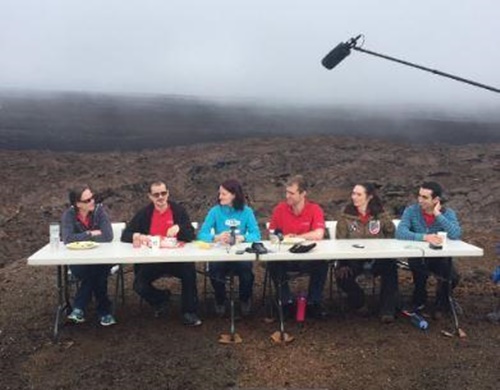
University of Hawaii Mars simulation crew exits their habitat on Mauna Loa Sunday after the completion of the year-long project.
Six crew members on a mock mission to Mars returned to society on Sunday after a year of living in isolation in Hawaii.
UH professor Kim Binsted, the principal investigator of the HI-SEAS project, said that everyone involved is "proud to be helping NASA reduce or remove the barriers to long-duration space exploration".
To make the "mission" as realistic as possible, the team had to live without any of their home comforts, and were only allowed to go outside if they were wearing spacesuits.
Fellow crew member Christiane Heinicke added she was amazed she could draw water from the "little greenhouse construct" in their simulated environment. On June 3, 2010, Russian Federation started its own simulation, keeping a team of people in isolation for 520 days.
Since last August, the German physicist has been living with five other people in a 1,200-square-foot, solar-powered dome on the side of a Hawaiian volcano in an experiment in Mars-like living.
Smartphone Not Getting Android 7.0 Nougat; Other Sony Devices Will Do
Unfortunately, much older Google Nexus models, such as the Nexus 5 and Nexus 7 (2013), won't be getting the Android 7.0 Nougat. HTC announced today that the unlocked HTC 10 will be first on the docket to receive Android 7.0 Nougat.
Nasa is aiming to send a crew to Mars sometime in the 2030s, but a one-way trip will take about seven months.
"Showing that it works, you can actually get water from the ground that is seemingly dry". "The technical and psychological problems can be overcome", Verseux said.
NASA can now send a robot to the Red Planet in about eight months, but astronauts traveling to Mars face a trip lasting between one and three years. This mission is its longest, but two more are planned for eight months each, beginning in January 2017 and 2018.
Scientists tested how they managed with limited resources while conducting research and trying to avoid personal conflicts. While they were able to communicate with the outside world, they could only do so by email, and the messages were relayed with a 20-minute delay to mirror the time it would take for the signals to bridge the gap between the Earth and Mars.
The six crew members also included Sheyna E. Gifford, chief medical and safety officer, and aerospace engineer Andrzej Steward. Bassingthwaighte served as the crew's architect. As the crew emerged into the overcast morning, Verseux joked: "We were hoping for some sun".
The University of Hawaii is now recruiting for crewmembers to take part in its next two missions, scheduled to begin in 2017 and 2018.

 German Economy Minister Says EU-US Trade Talks Have Failed
 Suspended Brazilian president's impeachment trial begins